









High School Grading Scale: Your Comprehensive Guide
Understanding the high school grading scale is essential for students navigating their academic journey and families supporting them through these crucial years. This guide breaks down how grades are assigned, calculated, and leveraged for success, offering practical strategies to maximize academic achievement and prepare for graduation requirements.
The Importance of a Standardized Grading System
Standardized grading creates fairness and transparency across schools, ensuring students everywhere understand academic expectations and performance benchmarks consistently.
Clarifying Academic Expectations
Uniform grade boundaries eliminate confusion by establishing clear performance targets that high school students can work toward systematically. When schools follow similar standards, students transferring between districts face fewer adjustment challenges. This consistency ensures fairness statewide, preventing arbitrary evaluation differences that could disadvantage certain student populations unfairly.
Tracking Student Performance Over Time
A clear grading system enables educators to monitor student progress across semesters effectively. These cumulative academic records become invaluable during college admissions, providing universities with standardized metrics to evaluate applicants fairly. Consistent tracking helps identify learning gaps early, allowing timely intervention strategies.
A Quick History of Letter Grades
The familiar A-F letter grade system emerged gradually in American education, replacing earlier numerical and descriptive evaluation methods over decades.
Origin of the A–F System
Early American schools borrowed grading concepts from European universities during the late 1800s. Mount Holyoke College pioneered letter grades in 1897, establishing the foundation for today’s grading scale. Letters replaced percentage-only evaluations because they simplified communication between institutions and provided clearer performance categories.
When Plus/Minus Grades Were Introduced
Plus and minus modifiers appeared in the 1920s as educators sought finer performance distinctions. This addition sparked debates about whether increased precision justified added complexity. Some argued these refinements motivated students, while critics claimed they created unnecessary stress and confusion.
Understanding Basic Letter Grades and Percentages
Most high schools follow a standard grading scale where A represents 90-100%, with subsequent letter grade ranges marking ten-point intervals downward.
A: 90–100%
Earning an A signifies exceptional mastery of course material and consistent excellence in assignments. Teachers expect A-students to demonstrate deep understanding, critical thinking, and ability to apply concepts creatively. This top-tier performance often requires going beyond minimum requirements consistently.
B, C, D, F: Common Ranges
The B range spans 80-89%, indicating above-average comprehension and solid performance. C grades at 70-79% represent satisfactory understanding meeting basic standards. D grades between 60-69% suggest minimal passing grade competency. F grades below 60% indicate failing grade status.
Breaking Down Plus and Minus Grades
The plus/minus system adds nuance to letter grades, recognizing performance differences within each ten-point range more precisely.
Why Plus/Minus Can Matter
These distinctions significantly impact final grade point average since an A-minus typically equals 3.7 grade points versus 4.0 for standard A. This precision motivates students near grade boundaries to push harder. Small differences accumulated across multiple courses substantially affect class rank and scholarship eligibility.
Typical Cutoffs for A−, B+, B−, etc.
Common thresholds include A-minus at 90-92%, A at 93-96%, and A-plus at 97-100%. B-plus typically covers 87-89%, while B-minus spans 80-82%. Schools vary these ranges based on local policies, making understanding your specific institution’s grading scale crucial.
GPA 101: Converting Letters to Numbers
Grade Point Average transforms letter grades into numerical values, creating a single metric summarizing overall academic performance for rankings and admissions.
Standard 4.0 Scale
The traditional four point scale assigns A grades four grade points, B grades three points, C grades two points, and D grades one point. Schools calculate GPA by multiplying each course’s grade points by credit hours, then dividing total points by total credits attempted. This standardized approach enables fair comparisons across different schools.
Weighted vs. Unweighted Calculations
Unweighted GPAs cap at 4.0 regardless of course difficulty, treating all courses equally. Weighted systems award extra points for advanced placement courses, potentially exceeding 4.0. This distinction rewards high school students challenging themselves with rigorous coursework while maintaining strong performance in demanding classes. See our online high school courses for options.
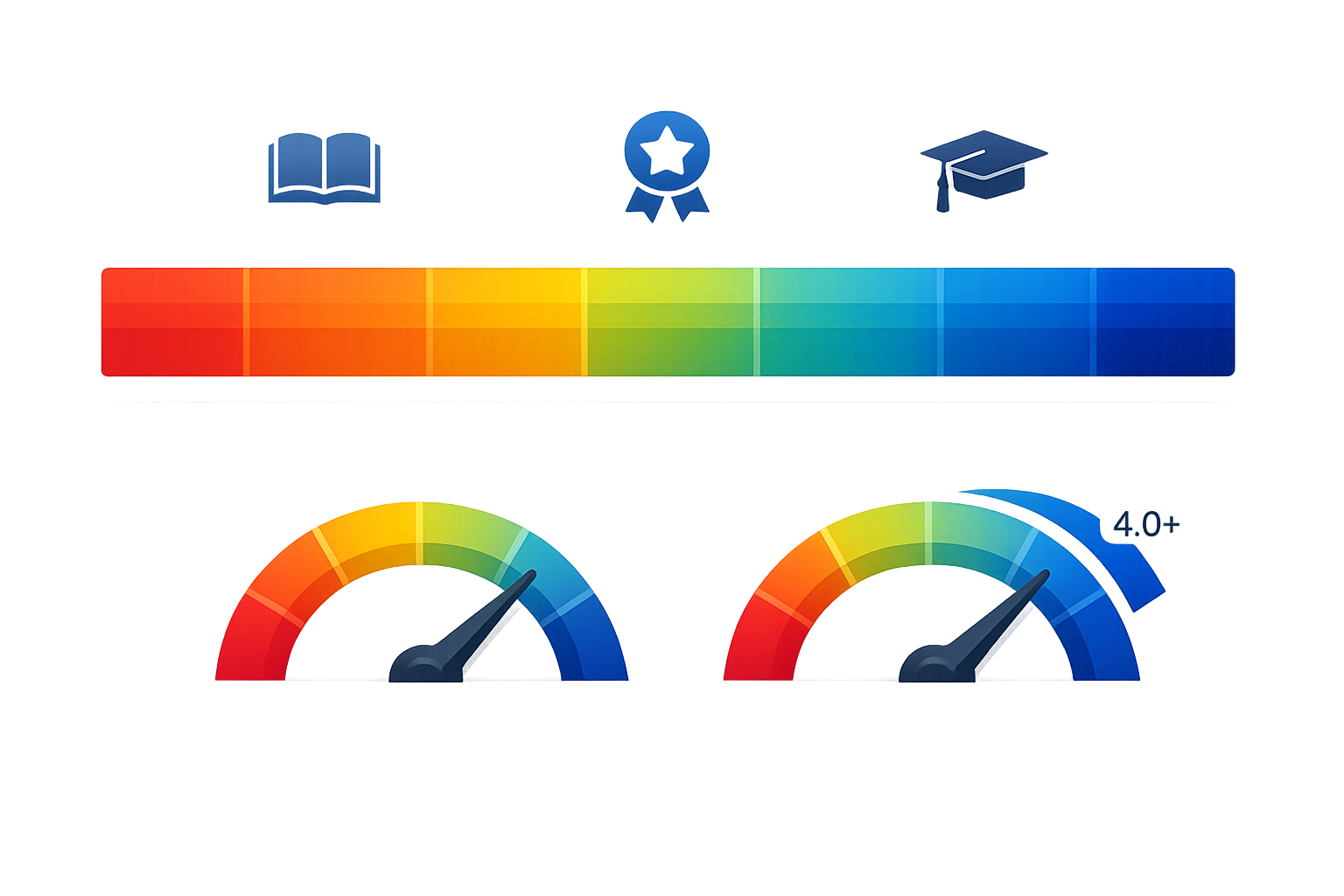
Weighted GPAs and Advanced Courses
Honors, Advanced Placement, International Baccalaureate, and dual enrollment courses often carry additional GPA weight, rewarding students who pursue challenging academic paths beyond standard curricula.
Honors Classes
Honors courses typically add 0.5 quality points to standard grade values, making an honors course B worth 3.5 instead of 3.0. School policies vary regarding which courses qualify for honors designation. These classes feature accelerated pacing, deeper content exploration, and higher performance expectations than regular courses.
AP/IB Academic Rigor
Advanced Placement and IB programs often add full quality points, making an A worth 5.0. These college-level courses culminate in standardized exams that earn credit at universities. Colleges value this rigorous coursework highly, viewing it as preparation for academic success at their institutions.
Pass/Fail and Alternative Grading Methods
Some courses use pass/fail evaluation instead of letter grades, offering different benefits and limitations for student transcripts.
Advantages and Drawbacks
Pass/fail grading reduces stress by removing grade pressure, encouraging exploration of challenging subjects without GPA risk. However, this system provides less precision for competitive college admissions and may not reflect actual performance levels. Some students lose motivation without traditional grade incentives pushing them forward.
Situations to Consider Them
Pass/fail options work well for exploratory electives, specialized seminars, or courses outside a student’s comfort zone. Some schools offer this for subjects where mastery demonstration differs from traditional testing. Students should consider long-term transcript implications before choosing pass/fail options strategically.
Grading on a Curve: Pros and Cons
Curved grading adjusts scores calculated based on class performance distribution rather than absolute percentage cutoffs, creating relative evaluation systems.
Normal Distribution Approach
Instructors using curves typically allocate grades by percentile rankings within the class population. This method ensures predetermined grade distributions regardless of absolute performance levels. Such systems intensify competition among classmates while potentially inflating or deflating individual achievement unfairly.
Implications for Class Rank
Curved grading can artificially boost scores in difficult classes or penalize students in high-achieving groups. This practice raises ethical questions about fairness when external factors beyond individual control affect grades. Students should understand whether their classes use curves before comparing GPAs across schools.
Detailed Example: Calculating Your GPA
Understanding grade point average calculation helps students track their academic standing accurately and identify areas needing improvement for their goals.
Step-by-Step Example
Consider a student with these semester grades: English A (4.0), Mathematics B+ (3.3), Science B (3.0), Social Studies A- (3.7). Multiply each by credit hours, sum results, then divide by total credits. This process yields the semester GPA, which combines with previous terms for cumulative calculations.
Common Pitfalls to Avoid
Students often forget accounting for course credit variations when calculating GPAs manually. Some overlook weighted honors course adjustments or use incorrect point values for plus/minus grades. Missing or incorrectly recorded grades significantly skew calculations, making regular transcript reviews essential for accuracy.
How to Raise Your GPA Strategically
Improving academic performance requires targeted strategies combining better study habits, course selection, and leveraging available opportunities for grade enhancement.
Improving Study Habits
Effective time management starts with creating structured study schedules and eliminating distractions during student work sessions. Active note-taking techniques like Cornell method or mind mapping enhance retention significantly. Breaking large assignments into smaller tasks prevents overwhelming situations and improves completion rates consistently.
Capitalizing on Extra Credit
Always inquire about extra credit opportunities early in each course to plan accordingly. Strategic enrollment in weighted honors courses can boost GPA even with slightly lower grades than regular classes. Balance course difficulty with realistic performance expectations to maximize overall grade point average gains effectively.

Common Variations Across Different States
Grading scales vary significantly across states, with some using seven-point scales where 93-100% equals an A versus the traditional ten-point system. Texas and North Carolina historically used different letter grade percentage cutoffs than California or New York schools. Some states mandate specific weighting policies for advanced placement courses while others leave decisions to individual districts. These variations complicate college admissions comparisons, prompting many universities to recalculate GPAs using their own standardized methods. High school students moving between states should request detailed grading policy documentation to understand how their transcripts translate. Additionally, understanding these differences helps families navigate the educational process when considering relocation or comparing schools across state boundaries effectively. See our education legal framework for details.
Tips for Parents to Support Student Success
Parents can help by establishing consistent homework routines and providing quiet study spaces free from distractions at home. Regular communication with teachers helps identify struggles early before semester grades suffer significantly. Encourage balanced course loads that challenge without overwhelming, considering your child’s strengths and graduation goals. Celebrate improvements rather than focusing solely on perfect grades, building confidence and resilience. Help research grading policies together, ensuring your student understands how their efforts translate into academic records supporting future aspirations. Additionally, understanding report cards thoroughly enables parents to provide targeted support where needed most effectively.

Frequently Asked Questions (FAQs)
Common concerns include whether schools drop lowest test grades, which varies by teacher and institutional policy significantly. Grade forgiveness policies allow students to retake failed courses, with some schools replacing the original failing grade entirely while others average both attempts. Summer school grades typically count toward GPA but may be weighted differently than regular semester courses. Online course grades usually transfer but require accreditation verification first. Understanding these nuances helps families navigate high school grading systems successfully while maximizing opportunities for academic achievement and college preparation. Report cards reflect these various policies differently, making communication with guidance counselors essential for clarity.