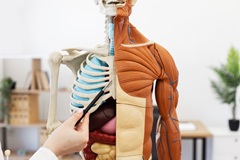




Anatomy & Physiology, Part 2
Price: $125 | Credits: One Semester | Dept: Elective | Course ID# 262-2
In Anatomy & Physiology Part 2, students investigate the major body systems responsible for movement, communication, regulation, transport, and reproduction. Students study the muscular, nervous, endocrine, cardiovascular, respiratory, digestive, urinary, reproductive, immune, and lymphatic systems, examining how each contributes to maintaining homeostasis. They explore the structure and function of organs, tissues, and physiological processes while analyzing common diseases and disorders that affect human health. Through scientific inquiry, laboratory investigations, data analysis, and real-world applications, students develop a deeper understanding of how body systems interact to support life and maintain the body’s internal balance The course is aligned with the Next Generation Science Standards (NGSS) and the National Health Science Standards (NHSS). It is approved by the University of California A-G as a laboratory science – Life Sciences (category D).
Upon completion of this course, the student is awarded 5 credits. Each credit corresponds to 15 hours of study. Of course, some students work more quickly than others, and some can devote more hours to study, so some students are able to complete the course at an accelerated rate.
LEARNING OBJECTIVES
In this module, students gain a comprehension of the following:
- The structure and function of the muscular and nervous systems, including muscle contraction, movement, nerve impulses, reflexes, and the special senses.
- The endocrine system, including hormones, endocrine glands, regulation of body functions, and endocrine disorders.
- The composition and functions of blood and the roles of the lymphatic and immune systems in protecting the body from disease.
- The structure and function of the cardiovascular and respiratory systems, including circulation, blood pressure, ventilation, gas exchange, and related disorders.
- The structure and function of the digestive, urinary, and reproductive systems, including digestion and absorption, waste removal, fluid balance, reproduction, and human development.
TOPICS COVERED
This course covers the following topics:
- Muscular System
- Nervous System & Special Senses
- Endocrine, Blood & Immunity
- Cardiovascular & Respiratory Systems
- Digestive, Urinary & Reproductive Systems